27/02/2022

26.02.2022 End of an era.

 *

Saturday 26th February 2022. Today I sold my collection of 40 Telavox clocks to a gentleman from Holland. He intends to start his own website on Telavox and share information on the maker.

 After 16 years of research and collecting examples I will no longer be updating this blog. Though I shall not be closing it.

 I will have to try and the find time to download the blog's contents for sharing with ClockDoc. A dedicated website. Housing a vast amount of knowledge and imagery on electric clocks, their history and their almost countless makers. 

 Thank you, to those few, who commented on the Telavox blog. Or shared images of their Telavox clocks and their private collections for inclusion here. Even now, in the time of the Global Internet and freely shared knowledge, the Telavox clock still remains a rare find. 

 150,000 Telavox clocks were made. Starting with the Nazi invasion of Denmark in WW2. A ban on production forced the well established radio and loudspeaker maker into finding alternative employment for his skilled workforce. The adaptation of the radio construction materials and furniture quality finishes were ideal. For producing a range of highly individual and uniquely decorative clocks. 

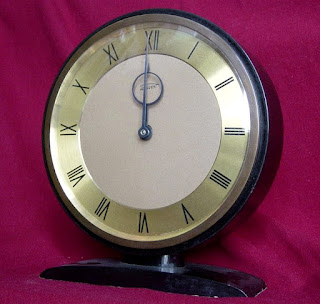
The Telavox Bakelite drum clock [above] was the first I found in an antique market in Denmark.


*

04/09/2021

4.09.2021 Telavox on eBay.

 *

A Telavox clock/timer is listed on eBay. In a pretty square dial case:

I have never found a Telavox clock/timer on my travels.

 Unusual Vintage Denmark Telavox Mantel Clock Rare | eBay


01/01/2011

A private collection

*
A collector of Telavox clocks has kindly forwarded some photographs with the case and movement serial numbers.

As I have yet to find at least two of these models myself this seemed like an ideal opportunity to show more of the Telavox case styles:


I like to think of this one as the tree style. Because of the grooved hardwood plinth which is rather like a stylised tree trunk. Providing a solid foundation to the entire design. It has a very pretty, delicately drawn dial with unique hands. The gilt corner swags (spandrels) add even more class to a very desirable Telavox.

Telavox Model 5020:

This is a very smart design with a solid chapter ring and excellent legibility thanks to the standard Telavox hands. The delicate lining to the curved edges of the case add a sumptuous quality. Well beyond anything seen in the more common, mass-produced, spring-driven clockwork made in Germany. Telavox designers had a superb eye for pure style.  

Telavox Model 5100

The wide, square stepped toe style. Again with lighter stringing lifting the case to a higher level. The plain brass dial suggests an early model.


I call this style the Art Deco. Probably because of the unique, curved hardwood, reeded feet. One of my favourite Telavox case styles. It looks as if it will spring into the air. Or is effortlessly supporting a heavy weight behind the dial.

Telavox Model 5080
Medium square toe seems inadequate to describe such a neat design. Note the beautifully grained, hardwood veneer, the hardwood edging and feet and fine contrasting lining. All indicators of a furniture quality clock case at its best.


The very wide, round toe model. Beautifully balanced thanks to the large, clear Telavox dial. Carved hardwood feet and neat edging strip add an extra touch of quality to the burr walnut veneer. Vertically reeded hardwood end caps to the case extremes complete a superbly impressive mantel clock.


Medium round toe with book matched, finely figured veneer with hardwood edging to the base. A polished brass chapter ring with Roman numerals and highly legible black Telavox hands.


A tall, Telavox wall dial in a unique style rather than the more usual mantel clock. The delicately drawn hands and cream dial with gilt, Arabic numeral are astonishingly clear and understated. Note the contrasting, curved lining to the front case veneer. The designer could have got away with plain top and bottom sections but chose reeded hardwood to raise the case quality to yet another level. Notice how the case is framed by the hardwood mouldings. This must have been an expensive case to make. Reminiscent of a true antique.

*

19/11/2010

Mystery Telavox 8649

*
A new owner of a Telavox has kindly sent me details and a link to some excellent pictures of his clock:

I have cropped, resized and adjusted the images slightly in PhotoFiltre to match the special requirements of the blog format. Without a little extra gamma and contrast blog images tend to appear dark and lack crispness. I routinely add gamma and contrast on all my blog images and may occasionally reduce the colour density slightly. This is no criticism of the original photographer's images because I do exactly the same to my own photographs on all of my blogs. 


Brass dial and fixed bezel, without the later chapter ring suggests an early clock. 

Telavox's typically attractive wood veneers with fine figuring and lighter box stringing for that extra touch of cabinet maker's quality. Telavox left most other clockwork case makers well behind on quality. Telavox clocks are always attractive pieces of furniture in their own right. This one is head and shoulders above any clockwork "retro" clock. The large, clear dial is nicely balanced by the width of the veneered case. Producing an attractive and impressive clock for any mantelpiece or sideboard.


 The rear view showing the fibre backplate also reinforces the style of an early clock. Fibreboard had a very long tradition in radio/electronics  production. A material which Telavox had used for  decades on their domestic electronics production pre-WW2. Note the typical, early, Telavox Bakelite, hand setting knob. Probably inherited stock from their production of electronics prior to the German occupation of Denmark during WW2.


An interesting shot of the undersides showing the Telavox serial number plate on the right and a rare rubber stamped date on the left. (as seen from this angle)  The quick-release, fibreboard cover rests below the clock. This provided tool-free access to the battery compartment and leads.


The date stamp of 19 Marts (Marts = March in Danish) 1945 confirms an  early clock too. Though there is no guarantee that these mysterious date stamps are contemporary factory markings. 8649 falls in 1948 in my own limited database. Yet 1945 date stamps appear on clocks of much later serial number.

 The battery leads seem to have a round, fibre, two-pin plug as used by the large 3V cell. Yet there doesn't seem to be enough space for such a large battery just here despite the quickly removable fibreboard cover. This may be an illusion of the viewpoint. The case may contain the earliest form of Telavox, non-striking, 3Volt movement. Hopefully the owner can confirm this later.

No sign of gongs through the aperture. I am having a little difficulty recognising exactly what can be seen through the aperture. There appears to be a Bakelite rating knob for a torsion pendulum and a hand setting shaft but I am not sure about the rest. (see also the image below) Is it really a rating knob? It would be the only one I have ever seen in Bakelite. The usual Telavox rating knob is a large, chrome-plated steel, straight-knurled screw head. Allowing the use of a screwdriver or finger adjustment.


The Telavox serial plate is found on every clock. Sometimes on the back of the case though just as often underneath. As suggested earlier, 8649 falls in 1948 in my database. So there is some confusion here over exact dating.

It is difficult to suggest what the other numbers mean. They could be production or stock marks of the factory, a clock repairer's, retailer's or wholesaler's marks. An auction house or even household insurance markings? KBM = København M? (Eng:Copenhagen Central ) Make your own guess.


The owner has kindly provided confirmation of the non-striking, early, 3Volt Telavox movement with a new image. Note the fibre disk at bottom right. This usually has two dissimilar  pins which fit holes in the 3V battery. The different diameters of the pins would ensure correct polarity when "plugged" into the battery. In this case the disk seems to have lost its pins and the bare-ended leads simply pass through the two original holes where the hollow pins once fitted.

Those interested in seeing the owner's much larger images may like to use the following link and select "Original":


http://www.flickr.com/photos/kause/sets/72157625420282822/

I have a similar (much darker) clock case with a 1945 date stamp but it has been converted to a synchronous, mains motor. Another similar clock case has a later, gong-striking movement.This suggest (to me at least) that this case style lasted for some years while Telavox clock movements continued to evolve.

Click on any image for an enlargement. Back click to return to the text.


*

16/06/2010

A synchronous Clementa

*
I have found a mains driven Clementa in rather poor condition. The brasswork is corroded and the hardwood surround is stained. Believe it or not the entire dial is laminated and turned hardwood. Sadly, it must have been stored somewhere damp.


 The dial with solid brass Roman numerals. There is rather a lot of staining to the hardwood surround suggesting rain may have collected there.


The dial without the hardwood centre and motor.


 The mains synchronous motor is concealed within the protective can. The motor is typically non-self starting. This avoided confusion over the correct time if there should ever be be an interruption to the mains power supply. Had the clock restarted the owner would have been completely unaware that the clock showed the wrong time. When these clocks were new they would probably be the only reliable form of timekeeping in the house. A fine pull-cord passes into the can to start the motor. A hand setting knob is also provided in the side of the can.


 This heavy Bakelite case never saw a Telavox torsion pendulum movement. Though this is the same case as used on the Telavox drum clocks. Perhaps it was a matter of economy to use up existing Bakelite cases? These Bakelite cases were very early in Telavox production history. (around 1942)


 The typical Telavox-style, steel backplate closing the rear of the Bakelite case. Note the obscuring cloth typical of Telavox clocks.Since it has never been perforated at the centre one can assume that no hand setting knob was ever used with this particular case.


The back of the turned wooden dial. Turned from solid hardwood laminated from separate pieces glued together. This must have been rather a costly exercise. The perforated decorative brass rim and cloth covered backplate suggests sound should be allowed to escape freely. Yet no striking mechanism is present.


Click on any image for an enlargement.
*

10/05/2010

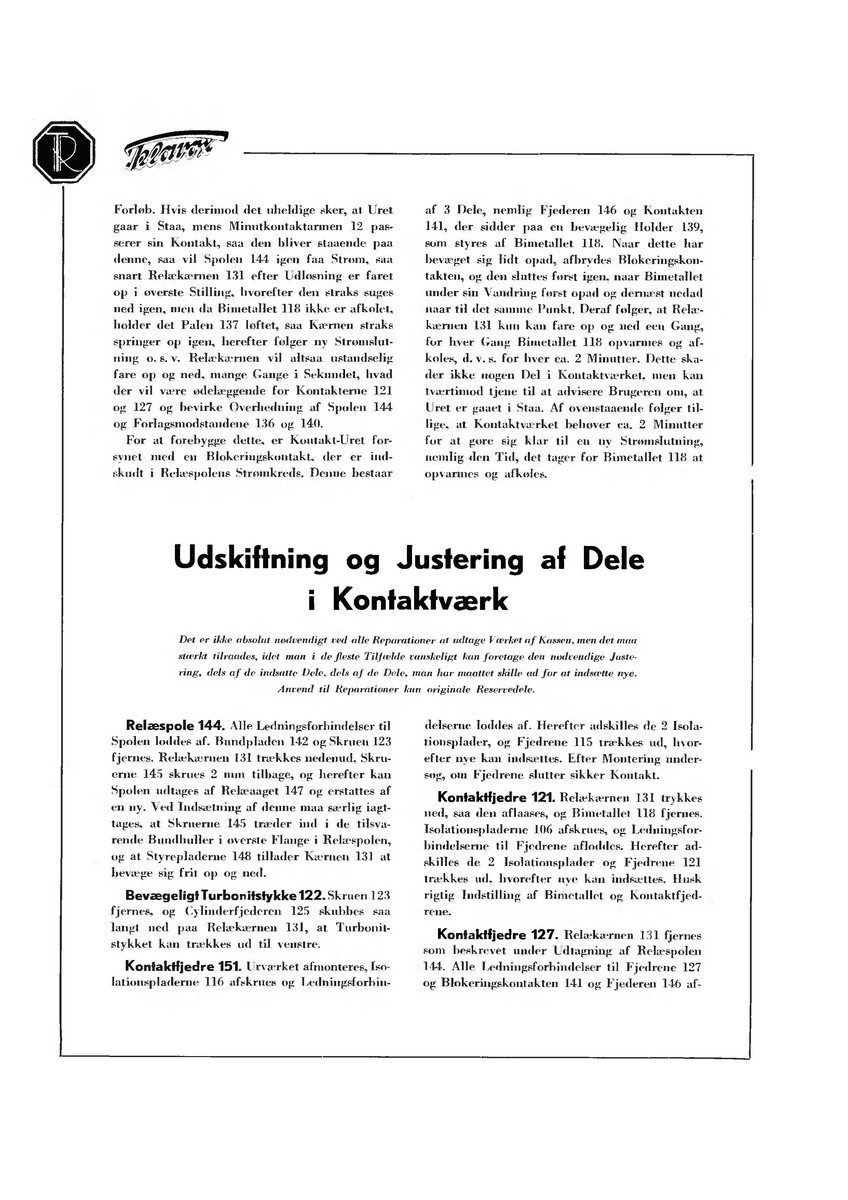
Telavox Service Instructions

*
PLEASE NOTE: My intention was to translate these Danish instructions into English. However the pages are images rather than text. So it is very time consuming to translate by jumping back and forth between the images and  a text formatting software. I shall persevere, as time allows, but patience will be required. The highly technical nature of the printed descriptions adds to the problems in translation. 
__________________________________________________

These Danish Telavox Service Instructions were kindly sent to me by Bjarne Jensen. Proprietor of the Funder Radio and railway museum near Silkeborg in Denmark:

Funder.Nr.Hede Banen & Funder Radiomuseum -

I will try to translate the text pages into English as time allows. Though the complexity of the movement and the very long parts list may defy my best efforts to give them correct (horological) English names.

I have resized the original scans, which were kindly provided by Bjarne, to avoid large downloads for those browsing the Telavox blog. With so many illustrations it is inevitable (and unavoidable) that some chapters will be slow to download on a slow internet connection. Having always had a broadband connection, with steadily increasing speed over time, I tend to take fast downloads completely for granted. If you are on a very slow connection and pay for bandwidth then I suggest that you don't enlarge images unnecessarily.

Page order is only provisional at the moment. Since the pages are not numbered I have put them in numerical order as they were sent to me.  I shall try to improve the layout of this chapter over time.

As I have been looking for Telavox service instruction for over ten years I am very grateful that Bjarne has shared these instructions with me. Hopefully others will find them valuable in adjusting and maintaining their Telavox clocks once they have an English version.

Cover page. Telavox Electric Clocks Service-Instructions.


SERVICE INSTRUCTIONS for TELAVOX ELECTRIC CLOCKS.


The Telavox Factory in 1936. Just 6 years prior to clock production which started during the German occupation of WW2. 


Description of the clock mechanism's function.


Adjustment of clock contacts.


Function of the contact works.


Parts list for the clock mechanism.


Labelled Illustrations of time switch movement 1 and 2 follow.


Time switch movement 1.


Time switch movement 2.


Rear of Telavox time switch case and back plate.


Dismantling, Cleaning and re-assembly instructions.


Add caption


Service Instructions.


Illustration of contacts Figures 3 and 4 follow.


Time switch mechanism. (labelled)


Time switch backplate (labelled)


Removing and adjusting of contact parts.


Diagrams of the time switch contact mechanisms. 


Changing the contacts.


The early, non-striking Telavox movement with labelled parts.


New construction of the contact mechanism.

Click on any image for an enlargement.
*
30/08/2006

Introduction:

.


If this blog is taking a long time to download on a slow connection try clicking on the chapter titles individually.

If you find the text too small try pressing CTRL+.
Press CTRL0 to return to normal size.


The dates of the following chapters are completely fictitious and only entered to ensure a logical order. This blog has actually stretched over three years and the newest chapters have the oldest dates.

The blog format was deliberately chosen for this project to allow much greater flexibility in posting, enlargeable images (by left clicking on them) and regular updating. Some of my once-free websites have had three changes of ISP hosts in as many years. All five of of my originally free websites have now been deleted by (agent) Orange to increase their profits.

Please ignore the automatic post dating completely. Newest chapters are actually the oldest and all dates are completely meaningless anyway. I actually enter the chapter dates manually just to organise the sequence of "chapters" logically. Blogs do not allow automatic reverse dating so new material appears at the bottom of the chapter list.

If you can see only one chapter then click on "Home" at the bottom of the page to view the entire blog from top to bottom. This may suit those with a fast Internet connection. Those still on a slow connection may prefer to select from the chapter list on the left and browse the chapters individually to avoid waiting for all the images to download simultaneously. Most of the images can be clicked on for a larger version. Use your own discretion whether you have the patience to wait and see the larger version download. Enlarged image size will vary but may be up to a maximum of 300kB!

I'd like to thank all of those who have contacted me with information on their Telavox clocks. Particularly those who have shared images and the serial numbers and descriptions of their own clocks. I look forwards to receiving details of your Telavox or Clementa clocks. My new email address appears in the "Database Appeal" chapter below.

Please note that I cannot advise on the value of any Telavox clock. Condition, originality, case style, veneer, age, rarity, dial and even the country in which it resides will all greatly affect the value.

Telavox clocks very rarely come up for auction on eBay. Danish prices are low but the clocks are still very difficult to find. Elsewhere they are even more difficult to find but fetch higher prices for rarity value to clock collectors. eBay auctions will usually find the highest price the market will bear simply due to their huge, international audience. There are large numbers of clock collectors across the world but far fewer who collect electric clocks. This does not mean that electric clocks do not fetch high prices if they are rare enough, in good enough condition and interesting enough to make them desirable. It is impossible to say whether this applies to Telavox clocks since so few ever appear on eBay auctions.

If you cannot get your Telavox running using the simple instructions in the chapters below then please contact a professional clock repairer for advice. I have yet to find a repair guide of any kind so I am really no wiser than you when it comes to adjustments or repairs for non-working examples.

If you know of, or own, a Telavox clock repair guide then I would be very grateful for a copy. A photocopy or computer scan would be very useful.


If you have a repair manual and wish to sell it then please contact me with some idea of the price expected so that I may purchase it (if affordable) and then share the information contained there with a wider audience via this blog.

If you find the text too small then simultaneously pressing Ctrl and + will enlarge the text. Pressing Ctrl - will reduce it. Pressing Ctrl 0 (zero) will return it to its original size.
.

29/08/2006

The Telavox Clock

*


Telavox clocks are easily identified by the lack of winding squares and the unique dial, hands, signature and chapter ring. In this example these features are seen in a very attractive, but slightly unusual, early, Bakelite drum case with wooden foot.

Telavox is pronounced TEE-la-voks in Denmark with the emphasis on the first syllable. It is only in Denmark that these clocks are usually found. Though examples have been taken abroad possibly by emigrants. They are surprisingly difficult to find even in Denmark. As a collector on the constant lookout I rarely see more than one Telavox clock in six months. These clocks attract only very low prices in Denmark. Probably because so few people, including clock repairers, understand them. So dealers cannot get them to run reliably and they are put into storage or discarded along with the now out-of-fashion, mass-produced, clockwork mantle clocks. Or worse: A cheap quartz movement is installed to replace the excellent original Telavox movement in the hope of selling the clock as an unusual "goer". Perhaps to a home decorator with a taste for "retro" but without the usual loud tick of a "clockwork" clock.

Instructions are provided here to get a striking Telavox or later Clementa clock to run:

After checking that the 4.5V battery is in good condition with a voltmeter or 4.5 volt torch bulb (or after replacing the old battery with a matching new one) the clock must be made to strike repeatedly to rewind the going spring. The rewinding and striking is driven by the battery but the going (ticking) is powered by a small spring which is rewound on every strike.

Using the knob provided at the back of the case advance the hands slowly *clockwise* to the next hour or half hour. You must wait patiently to allow the clock to strike each time until it stops by itself. After a few strikes the clock should be rewound and may be left to run after setting the hands to the proper time. The clock will then keep itself fully wound by striking normally at the hour and half hour as it tells the time.

If the clock stops after a while then allow it to strike a few more times by advancing the hands slowly and carefully as described above. Patience will usually be rewarded. Trying to move the hands on too soon may produce a buzzing noise as the clock parts rub against each other. This should be avoided or serious wear may take place.


Later Clementa instructions suggest that the clock be made to strike each hour (and half hour) right around the dial three times.  This is required whenever the clock has not run for a long time or when the battery is replaced.

A non-striking Telavox clock uses a large (and probably obsolete) 3V battery. Polarity may be important even if you can still find a battery. Or use modern batteries to obtain 3V. The original  battery leads had a simple fibre plug with two, odd-sized, brass pins to match the holes in the top of the battery. 

This later chapter illustrates the original batteries:

http://telavox.blogspot.com/2006/08/batteries-old-and-new.html

If you do click on a link or any image (for an enlargement) always back click to return to the text.
If you simply close a link or image your browser will also close.
 *

28/08/2006

Telavox Clocks

.
TELAVOX
was a Danish company which prior to WW2 manufactured radios, loudspeakers and radiograms.

The German occupation of Denmark during WW2 forced the company to find alternative products to keep the staff employed and the company running.

The Director chose to design and manufacture battery-driven domestic clocks. He designed an unusual movement which utilised a torsion pendulum driven by a small spring. This driving spring was rewound at frequent intervals by the simple motor-driven striking mechanism. This method of operation resulted in excellent timekeeping since battery strength is completely divorced from the driving force.

The need for a variety of cases for these clocks must have kept the existing force of cabinet makers busy.

All striking models were powered by a 4.5Volt flat style of battery. These batteries were once commonly used for torches and bicycle lights but are rather more difficult to obtain these days. The battery was always given a secure resting place in a cutout within the clock case. Spring clips on short wire leads allowed secure battery connection to the movement.

Telavox movements were standardised into three basic types in all the examples I have seen so far: Non-striking, striking on a small highly-polished bell and striking on gongs. The number of hammers and gongs varies from one clock to another and may well have offered a choice to the paying customer. Or may have been available during a particular period of time.

All movements are separately marked with their own serial number hot-pressed into the fibre backplate. All cases have their own unique serial numbers on an attached metal plate. Often these are placed out of sight on the bottom of the case.

The image below shows an example of an early, non-striking movement with an unusually large battery space. Note the typical Telavox hand adjusting knob. Probably borrowed from the former radio department stockpile when radio production stopped.

All Telavox clocks seem to employ a form of resin fibreboard, similar to Tufnol, for the movement plates. This material was very strong, non-corroding, offered low friction for the movement pivots, was electrically non-conducting and probably avoided the need for frequent oiling. (though not completely) This ideal material may well have been borrowed from their circuit boards used for their radios and gramophone audio amplifiers. The insides of all Telavox clock cases actually smell just like old radios.

Telavox had a long history of using very high quality veneers to finish their wood and plywood cabinets for their pre-war consumer electronics. This finishing method continued with most of their clock cases. The wide variety of superb wood veneers can be seen throughout this blog.

Some wall-hanging models were manufactured but the majority of Telavox clocks seem to follow the popular style of mantel clocks in a variety of styles. Though the quality of Telavox cases is often very much higher than mass produced, wind up clocks. The styling , though obviously a matter of personal taste, is often more refined than the more common spring driven clocks too.

Analysis of case design against case serial number suggests an evolution of case style over time. With earlier models no longer produced once newer models were introduced. (this case chronology has yet to be confirmed and is  based on a very small sample of those available)

Click on any image for an enlarged view. Back click to return to the text.

27/08/2006

Variations on a theme


*


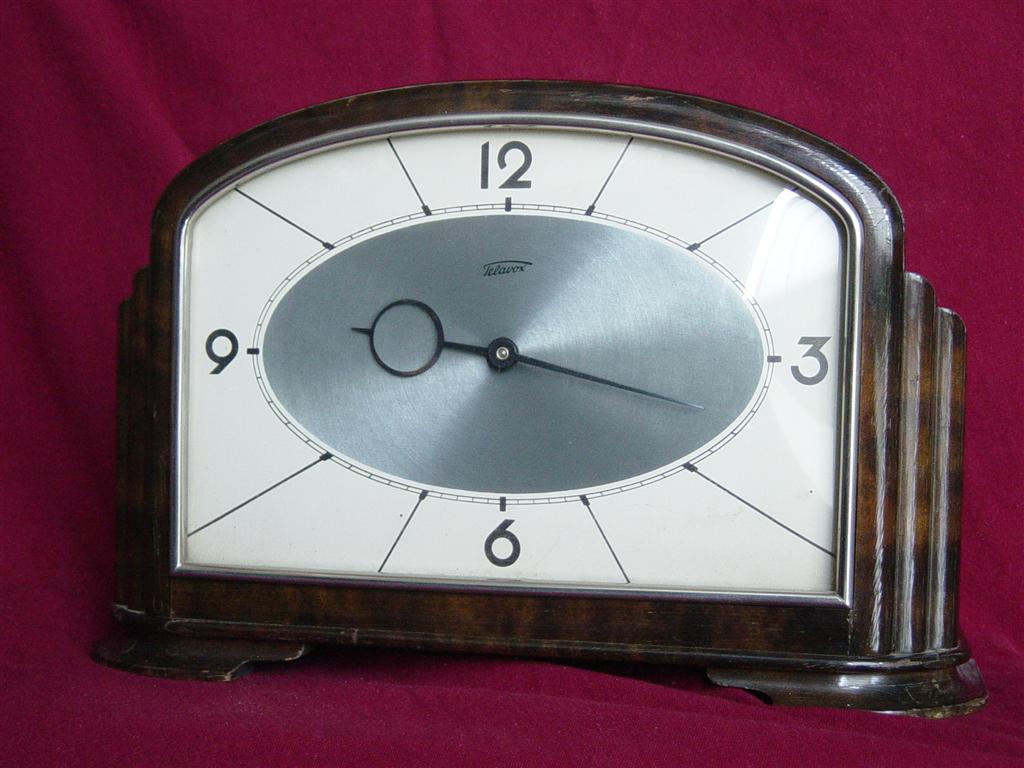
Here is an unusual Telavox clock. The Model 5060.

The dial, case and glass are all quite unlike the usual designs from this manufacturer. One might think from the serial number that this was a later clock yet it shows all the hallmarks of an early one. A lavish case with a simple going movement? No strike on bells or gongs? More than one of these clocks must exist because there is an illustration of this clock in a popular British clock collectors book.


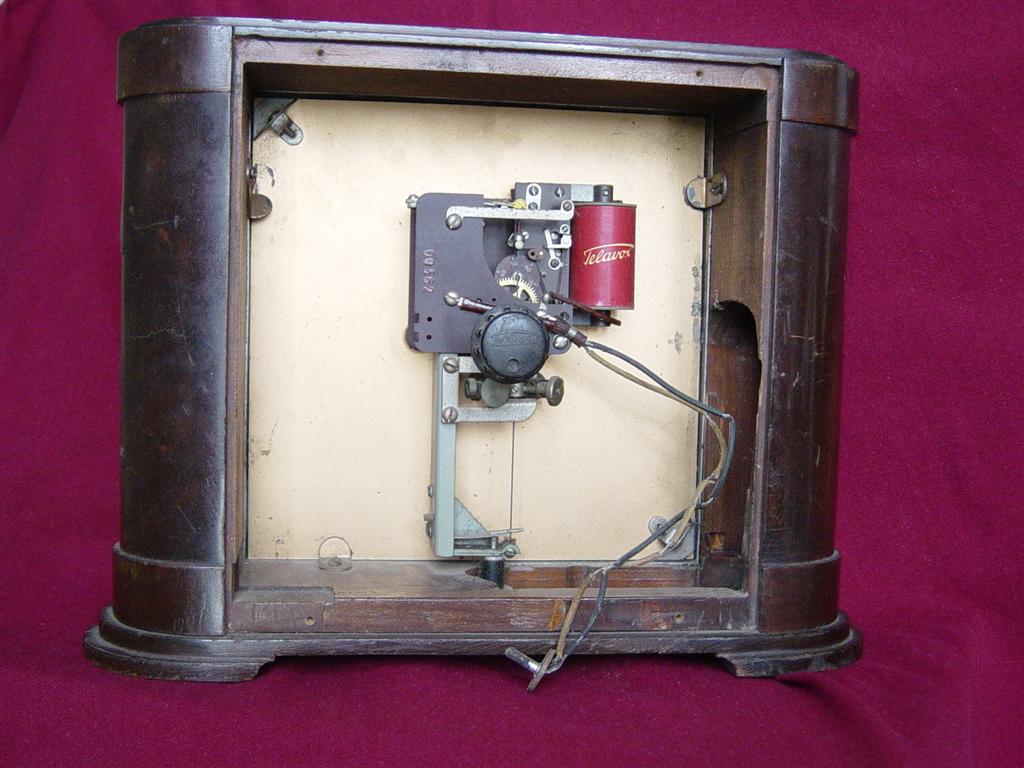
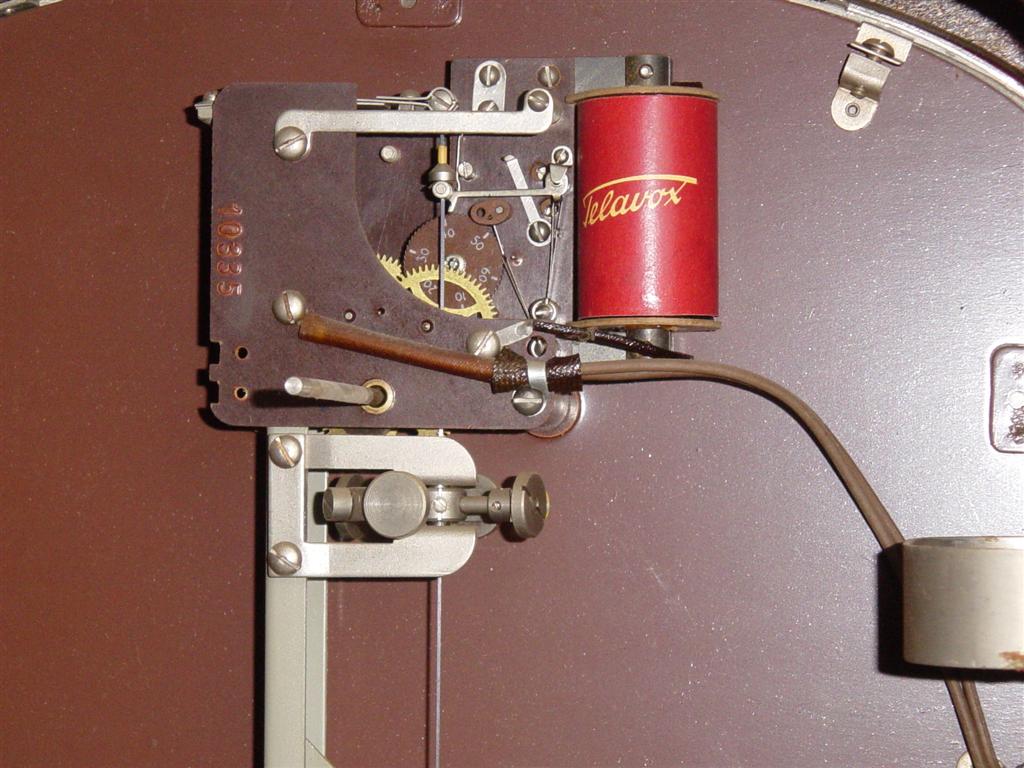
Here is a rear view showing the going movement in close-up. Comparison with the other images shows a bright red coil on the right in place of the electric strike/rewind motor. The torsion pendulum can be seen with its suspension spring passing right through the movement.


All Telavox clocks were supplied with a shaped piece of card to support the torsion pendulum balance when the clock was being moved around. Despite the absence of a single example of this piece of card not one of my clocks has suffered obvious damage to the pendulum, movement or suspension spring. Some cases show obvious mishandling since they were no longer in daily use yet all movements have survived unscathed. This would suggest that these clocks were remarkably robust in use.


The card says in Old Danish: Security for the suspension spring. Remove before setting the clock going. Replace (under the balance) every time the clock is to be moved.

Click on any image for an enlargement.
*