30/08/2006

Introduction:

.

If you find the text too small try pressing CTRL+.
Press CTRL0 to return to normal size.


The dates of the following chapters are completely fictitious and only entered to ensure a logical order. This blog has actually stretched over three years and the newest chapters have the oldest dates.

The blog format was deliberately chosen for this project to allow much greater flexibility in posting, enlargeable images (by left clicking on them) and regular updating. Some of my once-free websites have had three changes of ISP hosts in as many years. All five of of my originally free websites have now been deleted by (agent) Orange to increase their profits.

Please ignore the automatic post dating completely. Newest chapters are actually the oldest and all dates are completely meaningless anyway. I actually enter the chapter dates manually just to organise the sequence of "chapters" logically. Blogs do not allow automatic reverse dating so new material appears at the bottom of the chapter list.

If you can see only one chapter then click on "Home" at the bottom of the page to view the entire blog from top to bottom. This may suit those with a fast Internet connection. Those still on a slow connection may prefer to select from the chapter list on the left and browse the chapters individually to avoid waiting for all the images to download simultaneously. Most of the images can be clicked on for a larger version. Use your own discretion whether you have the patience to wait and see the larger version download. Enlarged image size will vary but may be up to a maximum of 300kB!

I'd like to thank all of those who have contacted me with information on their Telavox clocks. Particularly those who have shared images and the serial numbers and descriptions of their own clocks. I look forwards to receiving details of your Telavox or Clementa clocks. My new email address appears in the "Database Appeal" chapter below.

Please note that I cannot advise on the value of any Telavox clock. Condition, originality, case style, veneer, age, rarity, dial and even the country in which it resides will all greatly affect the value.

Telavox clocks very rarely come up for auction on eBay. Danish prices are low but the clocks are still very difficult to find. Elsewhere they are even more difficult to find but fetch higher prices for rarity value to clock collectors. eBay auctions will usually find the highest price the market will bear simply due to their huge, international audience. There are large numbers of clock collectors across the world but far fewer who collect electric clocks. This does not mean that electric clocks do not fetch high prices if they are rare enough, in good enough condition and interesting enough to make them desirable. It is impossible to say whether this applies to Telavox clocks since so few ever appear on eBay auctions.

If you cannot get your Telavox running using the simple instructions in the chapters below then please contact a professional clock repairer for advice. I have yet to find a repair guide of any kind so I am really no wiser than you when it comes to adjustments or repairs for non-working examples.

If you know of, or own, a Telavox clock repair guide then I would be very grateful for a copy. A photocopy or computer scan would be very useful.


If you have a repair manual and wish to sell it then please contact me with some idea of the price expected so that I may purchase it (if affordable) and then share the information contained there with a wider audience via this blog.

If you find the text too small then simultaneously pressing Ctrl and + will enlarge the text. Pressing Ctrl - will reduce it. Pressing Ctrl 0 (zero) will return it to its original size.

29/08/2006

The Telavox Clock

.


An old Telavox advertising logo sawn from solid 18mm hardwood and probably intended for a showroom display.


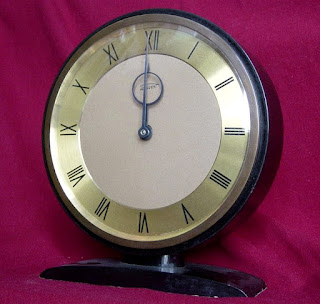
Telavox clocks are easily identified by the lack of winding squares and the unique dial, hands, signature and chapter ring. In this example these features are seen in a very attractive, but slightly unusual, early, Bakelite drum case with wooden foot.

Telavox is pronounced TEE-la-voks in Denmark with the emphasis on the first syllable. It is only in Denmark that these clocks are usually found. Though examples have been taken abroad possibly by emigrants. They are surprisingly difficult to find even in Denmark. As a collector on the constant lookout I rarely see more than one Telavox clock in six months. These clocks attract only very low prices in Denmark. Probably because so few people, including clock repairers, understand them. So dealers cannot get them to run reliably and they are put into storage or discarded along with the now out-of-fashion, mass-produced, clockwork mantle clocks. Or worse: A cheap quartz movement is installed to replace the excellent original Telavox movement in the hope of selling the clock as an unusual "goer". Perhaps to a home decorator with a taste for "retro" but without the usual loud tick of a "clockwork" clock.

Instructions are provided here to get an original Telavox or later Clementa striking clock to run:

After checking that the 4.5V battery is in good condition with a voltmeter or 4.5 volt torch bulb (or after replacing the old battery with a matching new one) the clock must be made to strike repeatedly to rewind the going spring. The rewinding and striking is driven by the battery but the going (ticking) is powered by a small spring.

Using the knob provided at the back of the case advance the hands slowly *clockwise* to the next hour or half hour. You must wait patiently to allow the clock to strike each time until it stops by itself. After a few strikes the clock should be rewound and may be left to run after setting the hands to the proper time. The clock will then keep itself fully wound by striking normally at the hour and half hour as it tells the time.

If the clock stops after a while then allow it to strike a few more times by advancing the hands slowly and carefully as described above. Patience in allowing the clock to strike fully before moving the hands onto the next hour (or half hour) will usually be rewarded.

28/08/2006

Telavox Clocks

.
TELAVOX
was a Danish company which prior to WW2 manufactured radios, loudspeakers and radiograms.

The German occupation of Denmark during WW2 forced the company to find alternative products to keep the staff employed and the company running.

The Director chose to design and manufacture battery-driven domestic clocks. He designed an unusual movement which utilised a torsion pendulum driven by a small spring. This driving spring was rewound at frequent intervals by the simple motor-driven striking mechanism. This method of operation resulted in excellent timekeeping since battery strength is completely divorced from the driving force.

The need for a variety of cases for these clocks must have kept the existing force of cabinet makers busy.

All striking models were powered by a 4.5Volt flat style of battery. These batteries were once commonly used for torches and bicycle lights but are rather more difficult to obtain these days. The battery was always given a secure resting place in a cutout within the clock case. Spring clips on short wire leads allowed secure battery connection to the movement.

Telavox movements were standardised into three basic types in all the examples I have seen so far: Non-striking, striking on a small highly-polished bell and striking on gongs. The number of hammers and gongs varies from one clock to another and may well have offered a choice to the paying customer. Or may have been available during a particular period of time.

All movements are separately marked with their own serial number hot-pressed into the fibre backplate. All cases have their own unique serial numbers on an attached metal plate. Often these are placed out of sight on the bottom of the case.

The image below shows an example of an early, non-striking movement with an unusually large battery space. Note the typical Telavox hand adjusting knob. Probably borrowed from the former radio department stockpile when radio production stopped.

All Telavox clocks seem to employ a form of resin fibreboard, similar to Tufnol, for the movement plates. This material was very strong, non-corroding, offered low friction for the movement pivots, was electrically non-conducting and probably avoided the need for oiling. This ideal material may well have been borrowed from their circuit boards as used for their radios and gramophone audio amplifiers. The insides of all Telavox clock cases actually smell just like old radios.

Telavox had a long history of using very high quality veneers to finish their wood and plywood cabinets for their pre-war consumer electronics. This finishing method continued with their range of clock cases. The wide variety of superb wood veneers can be seen throughout this blog.

Some wall-hanging models were manufactured but the majority of Telavox clocks seem to follow the popular style of mantel clocks in a variety of styles. Though the quality of Telavox cases is often very much higher than mass produced, wind up clocks. The styling , though obviously a matter of personal taste, is often more refined than the more common spring driven clocks too.

Analysis of case design against case serial number suggests an evolution of case style over time. With earlier models no longer produced once new models were introduced.

Click on any image for an enlarged view. Back click to return to the text.

27/08/2006

Variations on a theme


Here is an unusual Telavox clock. The dial, case and glass are all quite unlike the usual designs from this manufacturer. One might think from the serial number that this was a later clock yet it shows all the hallmarks of an early one. A lavish case with a simple going movement? No strike on bells or gongs? More than one of these clocks must exist because there is an illustration of this clock in a popular British clock collectors book.

Here is a rear view showing the going movement in close-up. Comparison with the other images shows a bright red coil on the right in place of the electric strike/rewind motor. The torsion pendulum can be seen with its suspension spring passing right through the movement.


All Telavox clocks were supplied with a shaped piece of card to support the supposedly-delicate torsion pendulum when the clock was being moved around. Despite the absence of a single example of this piece of card not one of my clocks has suffered obvious damage to the pendulum, movement or spring. Some cases show obvious mishandling since they were no longer in daily use yet all movements have survived unscathed. This would suggest that these clocks were remarkably robust in use.
*

26/08/2006

Opposite extremes of case size and form

*
Here is an example of a large, wall-hanging Telavox with striking on a bell. The hinged rear door has been removed to show the movement.

Note the Telavox serial number label at the top of the back of the case. All Telavox clocks have their own serial numbers. As do the movements.

The white battery leads are seen hanging down from the simple electric motor which drives the strike and rewinds the going spring. These wires look like a later replacement. Some of the early clocks show signs of deterioration of the rubber insulation on the original battery wires.

In such a large case there seems to be plenty of room for the movement. Yet exactly the same movement has to fit into this Bakelite drum clock case seen below.


Here is a front view of the typical Telavox dial and hands used on most of their clocks.

On the right below can be seen the rear of the case. Many Telavox clocks have a round steel backplate which can be easily removed by rotation. The keyhole screw-holes allow easy removal without tools when the two small protruding knobs, fitted for this purpose, are used to gain leverage.


25/08/2006

Wide, wider or widest?

.
Wide?

At one point Telavox produced some very wide mantle clock cases indeed.

This is a more typical Telavox clock case and hands. This is the only white chapter ring I have seen so far. I think it gives the clock a rather crisp and modern appearance compared with the majority of more subdued Telavox dials.

The dial appears clearer here than some of my other photos simply because the glass was removed before I obtained this clock. Probably because it was broken. A new dial glass could be obtained through clock repairers suppliers.

It is very difficult to photograph clocks with domed glass over the dials. My trick is to photograph in a light place with a large black cloth behind the camera. Even so a slanted viewpoint seems essential to avoid annoying reflections of the camera on its tripod. I learnt years ago not to stand behind the camera to avoid seeing myself reflected in the glass on my photographs. Flash is best avoided and most of my dial images are taken with available light.


Wider? I call this style stepped, square toe.

The plain dials seem to indicate early clocks. This clock has a low serial number and strikes on a bell.

The battery compartment underneath has been rubber stamped with a date of 1944. I have now obtained a dark wood case with plain brass dial date stamped 1945. Unfortunately it is a quartz conversion. Sadly very few Telavoxes are visibly date stamped.


Or widest? This is the very wide, round toe in the database.

Here is an example of a very wide Telavox with a black chapter ring. The reflective brass numerals are causing problems for the camera.

Despite the wide case the bold Telavox dial and its size gives the clock a nicely balanced appearance. The very ends of the case are vertically ribbed with matching hardwood. The curly grained veneer on this clock case is superb.

Click on any image for a larger version. Back click to return to the blog.

24/08/2006

A going movement that wont go!

*
Click on any image for an enlarged version. Back click to return to the text.

Here is my earliest movement by serial number. No. 00562. I have labelled the movement's main parts and hope this will be clearly legible if you left click on the image. Back-click to return to the text.

Note the absence of a strike motor on the right. Instead of which a large electromagnet is fitted . This is one of only two non-striking clocks in my possession. The electromagnet rocks the small, oval fibre piece which I have labelled actuator. The actuator is fixed to the pivot of a rocking stator hidden out of sight between the movement plates.

As it rocks the actuator carries out two important tasks. It lifts the impulse arm which has the pendulum impulse pallet on the hook-shaped portion at its end. The impulse arm normally rests in the teeth of the 60 tooth fibre ratchet wheel. The impulse pallet pushes on a pin fixed near the top of the torsion spring. The impulse pin faces backwards. The depth of engagement is controlled by the flat metal piece which I have labelled as "Stop". The impulse pin banks on this stop as it rotates to the right. The impulse pallet has a little bump formed on the slope of the hook. As the impulse pallet rises and falls the bump gives the impulse pin a push. This maintains the torsion pendulum in oscillating rotary motion.

The actuator also steps the 60 tooth ratchet wheel forwards. The pinion of 4 leaves rotates the brass wheel immediately below it and eventually drives the clock hands via further wheels and pinions.

On my only other non-striking Telavox the application of a 4.5 Volt battery quickly stops the pendulum from rotating backwards and forwards! My hope is that the earlier movement can be made to run in order to discover the fault with the later example.

I was very disappointed to discover that a Telavox Repair Handbook listed online by the Danish Antiquarian bookshops had been sold or lost! Several decades of clock repair and collecting have not helped to fathom out the reason why this this clock refuses to run! The action seems very sensitive to the position of the Stop. Without a working example it is difficult to judge what the settings should be.


This older movement seems to have been attacked at some time in its history with a blunt screwdriver. Most of the visible screw heads show some damage.

This particular movement has also suffered from the breakdown of the battery lead rubber insulation. This has hardened and crumbled exposing the bare wires to shorting. This seems to have been a problem on some Telavox clocks as they clearly have non-original, much later battery leads. I have now replaced the damaged leads in an attempt to get the older movement to run.
*

23/08/2006

Dials, hands and paintwork.

Here's my earliest Telavox from the front. The movement is non-striking. The movement can be seen above in a previous post.

The hands are typically Telavox but here the dial is deeply engraved on solid sheet metal. The Arabic numerals and minute ring graduations are deeply cut.

Later Telavox chapter rings are painted (or more likely printed) and have no depth at despite appearances.

The domed glass is missing from the dial of this clock. My hope is to find another example like this to ensure a replacement glass matches the original.

The case veneer is in rather poor condition. The veneer must have been steamed to wrap round the tight curves of the side of the case. Subsequent dampness, heat or probably dry air from central heating has resulted in some cracking. This is repairable of course. Wood glue could be injected with a syringe through the cracks then the whole bound tightly with rubber bands while the glue dries.

Here is the dial of the large rectangular Telavox previously shown only from the rear. The style of the hands is unique to this clock. No other Telavox that I have seen, or own, has this hand design.

There is some dirt and cobwebs behind the dial. Which could be cleaned up by removal of the dial sheet towards the back of the clock. Photography was very difficult. Trying to get enough light to do the clock justice while avoiding reflections was a bit of a nightmare.

This clock strikes on a small, highly polished bell with a pleasant, clear tone. Slots in the case back are covered with the same type of coarse cloth common to most Telavox clocks. This allows the striking to be heard clearly in the room. In earlier times, when traffic noise levels were much lower than today's hectic world, a striking clock could probably be heard clearly throughout the house.

And now for something completely different. This is an example of a Telavox with a large case that has been painted. These particular colours were once popular for painting furniture of all kinds in Denmark. I have an unpainted example of this case style. I'm not sure I don't prefer the painted version to the acres of original, very dark brown veneer. The painting was certainly very well done. The question remains whether this was a short-lived fashion and when it took place. Changing tastes and changing fashions can be difficult to judge from our own perspective.

22/08/2006

Telavox Database Appeal

*
I am building a database of information concerning Telavox clocks and the later Clementas.

If anyone has a Telavox clock of any type (in any condition) please forward some details to the (new) email address below.

chris . b at nypost . dk

(Remove the spaces and use the usual symbol for "at")

Please forward the following information:
The Telavox case number (on attached metal label) and the movement number impressed into the movement plate.
Whether the clock strikes on a bell or gongs. (and how many hammers and gongs) Or if it is a non-striking movement. This all helps to build a history of Telavox clocks in the database below.

If you can find a date stamped anywhere on, or usually inside, the clock it would be very helpful to aid dating many more Telavox clocks. Some date stamps are even found in the battery compartment.
Please include information on dial type, colour of dial, whether Arabic or Roman numerals and hand style if non-standard.
An image attachment (of any size) to confirm case and dial type would be very useful, if possible. No image will ever be published without your express consent and I will always hide personal details.
Provided the clock is recognisable all Telavox images are useful. Even those taken with a mobile phone or webcam still shot. Lots of light helps to get a good picture so try photographing your clock near a large window or even out of doors. Sometimes an overcast sky is better than bright sunlight. Please don't drop your clock or damage it trying to get a good picture! Please be very careful when handling your clock or carrying it about. I cannot accept responsibility for any damage however caused.
Naturally your privacy and anonymity are guaranteed. No information will ever be published which could connect you in any way to your own Telavox clock or clocks. Ownership will NOT and never will be part of the database. In fact I keep no record of ownership at all. Not even your email address. 
Any size of Telavox image is perfectly acceptable. There is no need to compress or resize images before you attach them unless you wish to do so for your own purposes.
Naturally the details of your Telavox clock (even without an image) are also perfectly acceptable. Some descriptive guide to case style would of course be useful. There may be a similar example illustrated within this blog to help guide you in describing the case.
The database will be published here and can then be constantly updated as new information arrives.
Thankyou for your interest in sharing information on Telavox clocks.
Please note: I'm sorry, but I cannot offer valuations of Telavox clocks. Prices vary so widely depending on vendor, model, age, style, condition, originality, dial and desirability that it is quite impossible to give even a rough valuation. No clock is ever worth more than a buyer will pay for it. Even the cost of international postage can exceed the value of some clocks so eBay may not be the goldmine you hoped for.
Nor can I offer advice in repairing non-working Telavox clocks. A local qualified clock repairer may be able to advise. Please don't let them fit a cheap quartz replacement movement just because they don't understand the unique design of a Telavox clock! Your clock may simply require a new 4.5Volt battery. These batteries are not so readily available as previously. I find flea-markets sometimes stock them.
Allowing the clock to strike several times rewinds a Telavox clock. Just advance the hands slowly past the hour and half hour. Then pause and allow the clock to strike fully each time before continuing on to the next striking point. It really is as simple as that.
PLEASE BE VERY CAREFUL WHEN HANDING YOUR TELAVOX CLOCK TO AVOID
DAMAGE.
*

21/08/2006

Case styles galore!.

Telavox produced a whole range of case styles over the years.

Here, the solid wood base is nicely reeded to add a touch of extra quality. Note the small, decoratively-carved, wooden brackets at the junction between foot and dial. I am calling this case style "Art Deco".

The dial also has black Roman numerals printed onto lacquered brass.

The hands are absolutely typical black finished Telavox.


Here is a much more sombre version of the same style. Now the instantly recognisable Telavox chapter ring is black with the lacquered brass of the Arabic numerals showing through where they catch the light. It is much easier to read the dial than it first appears. The needs of photography forced a slanting viewpoint with a dark reflection from a large black cloth in the background behind the camera.

The hands are now brass finished rather than the more usual black.

Now we have a Telavox clock with gently curved shoulders. It has some slight damage to the veneer.

Brass chapter ring with black Roman numerals similar to the first clock illustrated above.

Black hands with a black Telavox signature on the dial.

The signature remains unchanged on all Telavox clocks I have seen. The name is most probably related to their much earlier radio production.


The alter-ego of the same round shouldered case style. Now with dark chapter ring, Arabic numerals and strikingly different wood veneer.

The hawk-eyed amongst you who left-clicked on these last two images (and no doubt others) will note the lack of dusting before the photography took place!


*

20/08/2006

Jørgensen's Telavox Clock

*
I have now obtained a copy of the Telavox 50th Anniversary booklet written by Dr.tecn. Peter Ørn (pronounced "Urn") This small 20 p.page A5 booklet celebrates Telavox loudspeaker production but offers very little information about Telavox clock production.

The booklet was provided with a limited edition copy of an earlier Telavox loudspeaker. The booklet contains a short history of Telavox and has small black and white illustrations of the factory, staff and Telavox' products. (but no clocks) It is written in Danish.


Ørn does mention that in WW2 production of radios had dried up. Whether this was because they were specifically forbidden by the German occupiers is difficult to judge. Later research suggests that radio valves became unavailable during the German occupation.

Fortunately, Jørgensen, who was the director of Telavox at the time, came up with a unique clock design with some advanced features. These movements would be built into a variety of high quality cases produced at their existing radio/loudspeaker factory in Vanløse. The factory had a staff of 250 at this point and the need to keep them occupied must have been a serious concern for the Telavox management.

Jørgensen's clock proved to be an accurate timekeeper thanks to details like a bi-metallic balance on the torsion pendulum. Ørn claims the Telavox clock was twenty times as accurate as clocks made by competitors. The regular, short rewind period of a small driving spring by the striking movements could be described as a rementoir. This design maintains a much steadier torque on the going movement than a typical spring-driven clock which runs for a week.

Ørn states that 150,000 Telavox clocks were manufactured from 1944-1952. These had 4 different movements and ten types of case. More than I have seen so far in my quest for examples to collect or photograph.

Jørgensen retired in 1952 whereupon Telavox production was split off between radio production and clocks. Telavox clock production was sold to Clementa. (presumably in 1952) Ørn goes on to say that clock production was still underway using the Clementa name in 1977 as the Anniversary booklet went to press.


Here is my only example of a Clementa in a wooden case. Tragically it has been converted to a quartz movement. Though the case shows all the signs of having originally had a Telavox-type of movement.

The dial has a hinged bezel. All Telavox clocks which I have seen to-date have fixed bezels with hand adjustment from the rear. In the picture below I have opened the bezel to better show the Clementa signature.


Note that the centre of the dial has been veneered. This is not a feature of any Telavox Clock that I have seen so far. It might be said that the dark hands and dark veneer do not make it easy to read the time in poor light.

19/08/2006

Lovely wood veneer


Here's an original natural wood version of the blue and red painted example. It needs a really good polish to revive the finish and to help to hide the scratches that it has accumulated since becoming "unloved".

This once popular case style can be found in spring driven clocks in antique markets by German makers. Though these clocks are easily recognised by the winding holes in their dials.
The Telavox can always be recognised by the lack of winding holes and the unique style of hands.

Here is a picture of a rather more handsome example kindly sent to me by its proud owner.
It is datestamped May 1951 inside the case and strikes on four gongs.


This style offers even more area for the veneer artist to show off his skills and the wide variety of exotic wood grains used by the Telavox craftsmen over the years.

This is the only example I have found so far with this very wide and tall case. The dark veneer is rather difficult to capture with the camera
It is certainly impressive in terms of sheer size.
On a suitable mantelpiece or sideboard it must once have been the pride and joy of the owner.
Sadly some mouldings are now missing.


This is the standard notice attached to Telavox clocks suitable for wall hanging. It goes into great detail regarding fixing to plaster or wooden walls. It is written in Danish.

More importantly, but not even mentioned on the label, is that Telavox clocks should be allowed to strike several times by advancing the hands whenever a new 4.5 Volt battery is inserted. This action rewinds the going spring and allows the clock to run reliably. Without knowing this it must have puzzled some collectors of Telavox clocks why their clock would not run for very long. With each new battery replacement the clock must be allowed to strike several times before being restarted.

Note that Telavox clocks strike a single blow on the half hour as well as counting the hours normally when striking on the hour. The striking Telavox movement is a very quiet clock when going and lacks the loud ticking common to spring driven clocks of this period.

The strike can be silenced by moving a lever on the backplate. This lever lifts the single hammer in the case of a bell strike. Or lifts all the hammers simultaneously in the case of gong striking.

The strike train must be allowed to run even when silenced or the clock will not be regularly rewound and the clock will soon stop.
*

18/08/2006

Telavox production

*
Here is a scan of one page of a 1977 booklet celebrating the 50th Jubilee of an earlier Model A loudspeaker. Naturally it is written in Danish. I have paraphrased the contents as follows:

It discusses that radio valves had became unavailable during WW2. At that time Telavox employed 250 people. Telavox had been well known for many years for their high quality workmanship and had produced cabinets for Philips (in 1930) amongst other manufacturers.

Jørensen (the ø is pronounced rather like the U in urn) the then director of Telavox used a bimetallic balance on his Telavox clock design to avoid temperature variations in its timekeeping. The booklet claims that the Telavox clock was twenty times more accurate than competitors. It does not mention which competitors. Perhaps they simply mean all clockwork mantel clocks?

From 1944 to 1952 Telavox manufactured 150,000 clocks with ten different case designs and four types of movement in Vanløse. Jørensen retired in 1952 and sold the business. At which time clock production was split off from radio manufacturing. Those interested in the electronics side of the business may like to browse for images of Telavox. There are a number of websites showing Telavox' domestic electronics products in the hands of private collectors.

Jørensen was obviously a far sighted and clever inventor. He designed and built a wind turbine which he placed on the factory roof. He hoped manufacture of turbines might be a future source of income and employment for his factory workers. The wind turbine produced electricity for many years and had a 10kW maximum output. Ironically Denmark now has the highest proportion of wind produced power than any other country and exports wind turbines all over the world.

Click for larger image. Back-click to return to the text.

17/08/2006

DATABASE:

.
A database of all Telavox and Clementa clocks which I have been able to examine, own myself, or have had the information forwarded to me by owners.

Not all clock details are always available. I sometimes find cases I am unwilling to buy at the asking price with a Quartz movement fitted.  Qrtz in the list simply means that a cheap, modern, quartz, battery driven, plastic replacement movement has been fitted to the clock in place of the original torsion pendulum movement.

Then there are clocks in poor condition which are ludicrously overpriced for the Danish market. I was once offered a number of bare Telavox movements by one dealer. He expected double the price for each movement I normally pay for a complete Telavox clock in fine condition! Tempting as it might be to have spare movements for empty cases I was hardly going to pay his silly prices. I was then accused, in a shop full of people, of being too poor to afford them! Unfortunately for him this particular fool is not so easily parted from his money.  Particularly for bare movements of unknown history.

Formatting of the database is a bit of a nightmare but will hopefully improve over time. (Try reloading the page if the list appears untidy) On one computer which I tried the movement number and striking were folded over to a new line. On other computers there is only one line per clock. Both my home computers show the details of only one clock per line without overlap. Your mileage may vary.

The order I have chosen to use is based entirely on case number. All Telavox clocks have a small, metal, numbered label attached. (usually out of sight underneath but sometimes on the back of the case) The visible (rear) clock movement plate always has another number hot-impressed into the fibre. One sharp-sighted owner pointed out that there are sometimes very small numbers and letters engraved on the back plate too. Though this is not commonplace and may be limited to a specific period of manufacture. Or even a specific clock.

The very few dated Telavox clocks found so far have what appears to be a common rubber datestamp marking inside the wooden case. I have shown these dates in bold type in the list to make them easy to find. These dates may help to aid (very rough) dating of your own Telavox clocks. Try matching the nearest case number or movement number to a dated example.

If you wish to have your own Telavox or Clementa clock details added to this list please email me at chris.b (at) nypost.dk. *Note the new email address* The old one was recently deleted when I changed accounts with my ISP. Please feel free to write in English or Danish. My written Danish is not very good but I understand written Danish well enough.

No information will ever be published which can possibly trace the owner of a clock. In fact I make no record of owner's details. Not even their email address. So once an email falls automatically off the bottom of my email folder (as it fills up) I cannot contact any clock owner even by their email address.

All information on Telavox clocks is of great value to help to expand the database. If you can find a datestamp internally then please include this with your clock details. Images of all Telavox or Clementa clocks are always very welcome. Any size of image attachment to an email is acceptable. I can't promise to use any image here unless the clock is particularly interesting. Though images do ensure there is no doubt as to case and dial style.

A bold number followed by an "a" in the following list means information was forwarded from a Telavox owner in response to my online appeal. (e.g. 5a) See email contact address above.

Abbreviations: Non S = Non Striking. HG= Number of Hammers and Gongs.

Dial details below are numeral style first, then colour, followed by chapter ring colour.

Case No.----Dial----------Case type-------Movt. No.---Strike

1--1578S----Blk on Gold----Bakelite drum----S01132-----Bell

2--1743s-----Gold on Blk---Bakelite drum----S01189-------Bell

3--2885s----Gold/blk--------Bakelite drum----S07622-------Bell

4a-3264s ---Gold/black-----Bakelite drum------------------------

5--3302-----Gold/blk-------Bakelite drum-----S12603-------Bell

6a--4324--Silver chapter ring-- small square wooden case---------

7--4352 S---Gold/Blk-------Narrow curved foot--S00642---4HG

8a-4511S---Gld Rom.Blk---Narrow curved foot--------------Qrtz

9--4548S --Gld.Rom Blk---Narrow curved foot---S01432---3HG

10a-4797---Gilt picture frame-------------------------------------- 

11--4818-----Silver chapter ring--early square----00562 --Non Striking

12--548S----Blk Rom. gold--narrow curved foot....S01432--- 3HG

13a-5040---Silv. chapt. Early square---S34956--- 13.5.45 ---Bell

14a-5604S---Blk/Gold----Narrow curved foot--S03188-----3HG

15a-6374S--Arabic/Gold---Narrow curved foot--S13401----3HG

16--7780----Gold/Blk------V. wide sq. foot------S 26948-----Bell

17-8427S---Gold/Black--Art deco --S 09363--1 Jan 1948---Bell

18a-8797S--Gold/Black--Art Deco- S10645--24May 1948--Bell

19-9562S---Blk/Gold-------Art deco carved foot

20-111615---Gold /Blk-----Narrow sq. foot----S 07932-----3HG

21-12994 S--Cream/Blk----Narrow sq. foot----S 15724-----3HG

22-12997 S---Cream/Blk--Narrow sq. foot------S 15670----3HG

23-13178 S----------------Very wide round toe

24-13978 S---Black/Gold--V. wide round toe---S 06767

25-14226 S----------------V. wide round toe

26-14288 S----------------V. wide round toe

27-14716S----Blk Rom---V.Wide rnd toe-S08363-4HG

28-15085 S---Black/Gold--V. wide round toe--S 08423

29a-16051S------?-------Bakelite drum--- 15953--- bell.

30-16662 Qtz. Gold/Blk----Narrow square foot--Quartz

31-18058 S----------------Narrow curved foot

32-18456---Silvered arched dial & case-10335-14 SEP 1945

33-19173s--Blk/Gold-Nrw curved foot-S 18780-2 FEB 1949

34a-20020--Blk/Gold-----Narrow square foot---S15067

35a-20479S-Blk/Crm--Nrw Sq Ft.-S16210-3H/G 28 OKT 1948

36a-20531--Blk/Gold---M/W Box in USA-10747- 22/8/1945

37-22430---Gold/Black---Narrow sq. ft.- Mains movement.

38-22575S-----------------Very wide round toe

39a- 23596---brass---Very wide square toe--10 Aug 1945


40--23750-- Very wide, sqr toe------Qrtz.-- 6 Sept 1945

41a
- 24138S-- S 15365--- Pretty mantle clock bell strike

42a--24612-Blk/Gld---V.wide stepped sq.--13345-Non/S

43a-24987S- Decorative-Pretty mantle-eBay--S20340-bell


44-25009S---White/blk-Wall, tall rectangular--S 1699-Bell

45-25739------------------Very wide square foot-----Bell

46-28474S-----------------Medium wide tall

47-28655S---------------- Painted Blue/Red-----------4HG

48-28680S------Medium wide & tall--24227----4HG

49a-29547S-----Medium wide & tall--S27625--4 HG

50a- 29922 -----Chromed wall dial
 
51-32831S---------------Clementa Hinged bezel----Qrtz

52--37134S-Clementa-Chrome Wall Dial-37134- Non-S.

53--38020S--Clementa--Chrome Plated Wall Dial---Qrtz

54-45094 S(?)-Medium wide, tall- S29957-20 DEC 1951

By sheer coincidence, No1 on the list was the very first Telavox clock I ever found. The dial bezel was already damaged and the brass work seemed to have been attacked by salty air or possibly a corrosive atmosphere. Rather sad, considering it is the oldest Telavox clock in my modest collection and first ignited my interest in Telavox as a clock manufacturer. This clock came from a coastal town with a prevailing, onshore wind. So that may be the reason for the dilapidation of its exposed metalwork. Particularly if it had been left in an open or unprotected situation.

The last clock on the list has a very high serial number indeed but has a Telavox case rather than the expected Clementa. Yet the movement number is earlier than the one remaining Clementa with an original movement.

It is a shame that the dated clocks are so relatively few. There are also some apparent anomalies where the date doesn't quite seem to match the serial numbers. If anyone has any real clues as to the reason for such occasional date stamping I'd be delighted to hear about it.

The small, but growing, number of clocks in the database is hardly representative of the many thousands actually manufactured. Though the list must be fairly indicative of the evolution of case style and numbering, over time, though surprises do crop up now and then.

*

16/08/2006

Bells, hammers and gongs

.
This is a close-up of a 4-hammer Telavox movement striking the hours and half hours on rod gongs. The levers activated by the movement lift two hammers each via two wires.

The strike silencing plate, operated by a lever underneath the case, lowers onto the gongs but leaves the hammers free to rise and fall.

If the hammers were restrained the clock would not strike, the clock would not be rewound and the clock would stop.


An unusual Telavox striking on a bell.


Don't forget that you can click on any picture on this blog to see a larger version.

Backclick to return to the blog.


15/08/2006

A Clementa Wall Dial

Here are some images of a chrome-plated steel, Clementa wall dial. Though the case has been converted to a cheap quartz movement it shows all the signs of having once had a Telavox type of movement. The correctly placed screw holes and 4.5 Volt battery retainer are all present. The Clementa label shows 38020S. A far higher number than any of my other Telavox clock movements. I like the crisp dial. What a shame the butcher who converted this dial to a cheap quartz movement was too lazy to adpat the original Telavox hands. (not a difficult task). The plain hands are much inferior to the Telavox hands but are easier to read in poor light.

Note: I can now confirm that this clock should have a Telavox type of movement as a Danish visitor to the blog contacted me to say he has exactly the same clock in his shop.


Click on any image for a larger version. Backclick to return to the blog.

14/08/2006

Batteries old and new

.
A number of non-striking clocks in my modest collection had a space cut out in the case for a much larger than normal battery. All striking Telavox clocks seem to require a standard 4.5Volts flat style of battery whether they strike on a bell or gongs.

Finally I have found a clock with an original large battery still in place! It turned out to be a very large, two-cell, 3 Volt battery with a socket in the top for a two-pin fibre plug. An image appears below showing the large battery beside two of the normal 4.5Volt batteries.

13/08/2006

Telavox Programmable Timer


I have been contacted by the owner of a remarkable Telavox device.
There is no other explanation other than it having been made at the Telavox factory.
The movement is a very early non-striking Telavox No.00304. This is the lowest movement serial number found to date!

The hands and early dial (without chapter ring) are typically Telavox as is the case. Even the Bakelite hand-setting knob on the back is clearly marked Telavox. What was the purpose of this very special clock/adjustable timer? It shows far too much investment in time, effort and skill to have been merely a one-off prototype.

If anyone has any further details they would like to share please do get in touch via the Telavox appeal email address: telavox.appeal@mail.dk


12/08/2006

Telavox security device.

The owner of the programmable timer has also kindly sent me this image of a simple device for securing the Telavox balance whenever the clock is moved.

It is a simple slip of card with a slot to fit around the suspension spring.

Printed on the card in old Danish it reads:

Security for the suspension strip.
Remove before starting the clock.
Should be placed under the balance every time the clock is to be moved.
On the edge in bold capitals is printed: PULL!

11/08/2006

A much-travelled Telavox


I was recently contacted by the owner of a Telavox. The clock had attracted their attention while they were on holiday in Denmark. So they bought it despite the problems of having to carry it about until they flew home. Bringing a ticking and striking clock onto a plane might have been difficult in these times of heightened security.


The owner kindly removed the backboard from the case to photograph the movement and note its number for my Telavox database. In doing so they discovered a datestamp inside the clock. Until I was informed of this datestamp I had never noticed such a thing in any of my own clocks. It seems that not all Telavox clocks are datestamped. The datestamp in the image seems to show 13.5(?).45. Which matches the likely age of the clock rather well. The very low case number on the label underneath the clock matches nicely too.

This clock retains its original dial glass unlike my own example which is in much poorer condition.

Now I shall have to try using a torch and mirror on my collection to see if I've missed a datestamp.

PS. When I checked my own clocks I found only one clearly date stamped: 1 Oct 1949. This is very disappointing since it doesn't help to date other Telavox clocks very accurately.

10/08/2006

A Clementa wall dial with original movement..

*


I have finally found a Clementa with an original movement. Note the similarity to the Telavox striking movement but with what appears to be the addition of a striking rack. It still has the Telavox style of striking motor over on the right of the main movement. Rather oddly there is no real striking mechanism.

The rack is gathered just like any other striking mechanism but seems to have the function of limiting going spring rewinding to a fixed maximum.


The clock is now running well with a new, flat-style 4.5 volt battery. It was reluctant to run at first but allowing it to strike repeatedly, by advancing the hands. rewound the going drive spring. A long, spring loaded, vertical hand adjusting rod is provided to avoid removing the clock from the wall when had resetting. The movement of this clock is slightly twisted relative to the dial which suggests somebody has dismantled the clock at some point. The backplate is also missing. At some stage somebody has sprayed paint across the insides. This shows up more in the bright lights of the video than still images.


I have been adjusting the rate since the clock was running very slow when it was purchased. Increasing the rate was easily achieved by raising the clip on the bottom of the torsion suspension strip. (by turning the large knurled screw head at the very bottom of the movement with your fingertips) This effectively shortens the free length of the torsion suspension spring. Thus speeding up the vibration of the torsion pendulum.

Only small adjustments should be made each time to the large screw head. The hands should also be set to the correct time whenever an adjustment is made to the rating screw. Over-adjusting the screw will make the timekeeping see-saw by as much as an hour per day. It is better to creep up on accurate timekeeping by making small adjustments then waiting for a day to see how the timekeeping has changed.

I must warn against trying to adjust the spring tension:

Do not attempt to turn the other screw head at the end of the suspension spring as this will almost certainly break the suspension strip!


Click on any image for a larger version. Backclick to return to the Telavox blog.

09/08/2006

Another programmable Telavox!

*
I was contacted by the owner of this clock who kindly provided me with the following images. The owner was hoping for a valuation but these clocks are so rare that it would be impossible to suggest a value considering the generally low prices for Telavox clocks in Denmark. It may appear one day on eBay if my suggestion is followed.

The plain dial suggests an early clock. What an attractive case with boxwood stringing against the dark veneer adding an extra touch of quality.


The fascinating "programmer" style backplate with outlet socket on the left.

The underside of the case.


The unique label on the underside translates roughly into:

Voltage as marked. Current maximum 2 Amps.


And, a vital date stamp too confirm when it was manufactured. So few Telavox clocks were date stamped that I wonder whether these stamps might be the mark of a special factory quality inspection. Pure speculation on my part but I wonder why so few were stamped during manufacture. Some of these date stamps would have been impossible to manage once the clock case was completed. For example: Date stamps inside the case and even in the battery compartment. Some clock repairers marked clocks as they passed through their hands but I don't think repairers were responsible for making these particular date stamps.

These images kindly provided by the owner, though very clear, are a little too small to allow enlargement by clicking on them.

*

08/08/2006

Another Australian exile.

*
Graeme Power, an Australian torsion pendulum clock collector, has kindly supplied some images of a unique and very attractive, Telavox clock which he has acquired. The movement strikes on a small bell with a beautiful tone.

The painted dial is very clear, crisp and tasteful with decorative, swag spandrels reminiscent of Art Nouveaux. The delicately drawn hands are similar to those on my own, much taller, rectangular, Telavox, wall hanging clock. The woodwork is of the typical high quality seen in all Telavox cases. The reeded bass might be thought to represent a tree trunk.

The serial number suggests a manufacturing date of the late 1940s based on the few dated examples known to me.

The backboard shows no sign of having been wall hung. Some examples of Telavox mantle clock may have been intended for the dual purpose of standing or hanging from a wall. Or may even have been wall hung by the owners. I wonder about the purpose of the holes in the corners of the door. Could these have been intended as fixing points for wall hanging?

The movement has lost its rating nut and lower suspension spring clamp. A search is on for originals if they can be found. Please get in touch if you can help.

I consider this is one of the prettiest Telavox clocks I have ever seen. I wonder how many other case and dial designs were made to fit the torsion pendulum movement by Telavox over the years? The designers seem to have produced a truly remarkable variety of case and dial styles. The Danes are renowned for their design skills in furniture and decorative objects. Producing many classical and highly collectable pieces.
*

07/08/2006

Telavoxes on eBay Oct ´09

*
Two fine Telavox clocks are on eBay at the moment from a German vendor.

Items numbers are 360196742799 and 360196742824 if you are interested. Copy and paste the numbers into the international eBay website. eBay seems to ignore saved searches for national versions of their auction services. Nor does it like fullstops at the end of item numbers.

These tall images, borrowed from their respective eBay auctions, are incredibly difficult to organise in Blogspot so I recommend you just click on them to see the original sizes. Back-click to return to this blog.

The clock case style on the left is new to me though there are very similar clocks with half round sides and similar, solid chapter rings. This item seems to have been converted to mains power so don't expect a true Telavox movement inside!

The clock on the right is the more familiar "very wide, round toe" of my own case style terminology. My thanks go, yet again, to Graeme Power of Australia for bringing these to my attention.

Good luck with your bidding! If you should win please forward the case and movement numbers to me so they may be added to the Telavox database. Please also check for internal date stamps.


06/08/2006

New case designs

*
Click on any image for an enlargement. Back click to return to the text.
Reload the page occasionally to ensure you are seeing the latest version.

My browsing recently brought me to an interesting Danish website. The website owner has a radio museum, amongst other things. Even more interestingly, for me,  he had a number of unusual Telavox clocks in his collection:

Here is a link to the website:

Funder.Nr.Hede Banen & Funder Radiomuseum -

Just click on the clock and your will be able to admire enlarged images in succession by clicking on the arrows below the images. 

There are also a good number of old photographs on the website with a distinctive nostalgic feel. I can remember steam road rollers working on the rural roads in my childhood. Steam trains were still in regular service in the UK until my teens.

Funder is near Silkeborg in mid Jylland, Denmark. I wouldn't normally mention the localion of any clock, or its owner, but in this case I imagine visitors are welcome at the museum when it is open. There is even a YouTube video of the narrow gauge railway in action busy carrying passengers.


This is a unique case style I would never have recognised as Telavox had it not been for the typical metal Telavox label displayed just below the clock. I really cannot remember ever seeing anything quite like it on my travels. Though it does have certain similarities to weight driven wall clocks where the weights and pendulum hang exposed below the dial. The hands are not like any other Telavox I have seen either. The dial is similar to some single handed, Danish, church clocks but the alignment of the hands here is pure chance rather than suggesting a single hour hand. The stamped numbers on the label look slightly odd too but one cannot discount it as non-Telavox on these grounds. I would very much like to examine this clock but as the museum is over 150km away that is rather unlikely in the near future.

Shown below is compact, square, wooden case with a different, but pleasing, appearance similar to those I already know. It is similar to the one which appeared in an auction on eBay but with added detail at waist height on the case sides. The lack of a mains plug suggests it may still have its original Telavox movement unlike the example on eBay.


This clock has the solid chapter ring similar to others of this family of case designs. The hands are typical Telavox and the number on the label suggests an early clock. It may be a non-striker or perhaps it has a bell.  There seems to be a hanging loop just visible at the top at the back of the clock case suggesting that it was wall mounted. Or had that facility if needed.

I am very grateful to the owner of the website for allowing me to share his excellent photographs here. The numbers of all the Telavox clocks in his collection have all been added to the database. One clock even has has a close serial number and similar datestamp to another already in the list. Further confirming such date stamping and chronological versus serial case numbering weren't just coincidence.

This later wall dial has a protective housing for the Telavox movement. The first I have seen on any Telavox clock. I have translated the instructions label below into everyday English:


 A 4.5 volt battery will be found in the packaging. The clips on the movement wires should be attached to the battery and the battery placed into its housing. The clock is fitted with an anchor escapement which is driven by a spring. The spring is wound a little every hour with the help of a little motor. Before the clock can run one should ensure that the spring is fully wound. This happens when the hands are advanced four times completely around the dial. Each time one should wait for 20 seconds as the minute hand passes 12 o'clock to allow the spring to be wound a full hour's worth by the motor. If you bring your ear near the clock you will be able  to hear when the motor stops. Once the spring is fully wound by the foregoing procedure the clock will run by itself. After each change of battery the clock should be rewound again.To start the clock it should be held upright and shaken with a brisk backward and forwards rotating motion.
REMEMBER TO REWIND WITH EACH CHANGE OF BATTERIES

It is very satisfying to discover yet more Telavox case designs. As soon as I become complacent and it seems that I have discovered them all along comes another quite distinctive style. Being able to add yet more clocks to the database all helps to identify trends in case and dial design over time and relative to their serial numbers.

Remember to back click to return to the text from links and enlarged images.
Reloading the page will ensure you enjoy the latest version.
*

05/08/2006

Telavox images

*
A contact with a Telavox has kindly forwarded some stunningly sharp images of the motor from his clock. He is dismantling the clock to clean it and took the opportunity to take some pictures. I was so impressed with John's photography that I thought his images well worth sharing. (after receiving permission of course) I have omitted John's surname to protect his privacy.

I should mention that I have resized the original images in PhotoFiltre to make them more acceptable to those viewers on a slow internet connection. The original images are razor sharp even when viewed full screen on my 23" monitor. Clicking on any of the images in this chapter will provide a superbly sharp 250-300kB enlargement. You may choose to click on them accordingly.


Here the energizing coils may be seen together with the stator and poles. The ratchet wheel is where a springy wire pushes to start the motor to begin the strike.(and simultaneously rewinds the going spring) The motor shaft is connected to a reduction pinion driving a fibre gear.


The view from the other side of the motor. Notice the motor has a number stamped into the end plate. The use of fibre plate for many components of the Telavox clocks is obvious from these fine images. This is a material borrowed from the Telavox radio production facility. A material with which Telavox had decades of experience for use in their domestic electronics.  Until, that is, clock production was introduced as radio valves (tubes) became impossible to obtain during the WW2 German occupation. It is known that the director was a clever and competent clock maker in his own right. This is clear from the ingenuity and skill he showed in designing such a unique clock movement. Which not only ensured the large, existing workforce could manufacture something completely new but also used many of the traditional skills with familiar materials. 


A general view of this clock. I call this the narrow, square, case style. (for want of a better description) I wonder whether Telavox had individual names for their case styles as they did for their radios? The box lining to the lower case and the superb veneering with exotic woods is a touch of pure quality.

The cream chapter ring is quite unusual and rather attractive. Offering superb clarity for reading the time in poor light. As is the sheer size of the dial in comparison with competing spring driven clocks of the same basic style. Many Danish homes had small, multi-paned windows until well after the war when picture windows and bungalows became more commonplace. Indoor, natural lighting levels were often quite poor. The housing stock was typically old, timber framed cottages and farmhouses of the rural scene and many are still found even in many towns and major cities today.  

Note how the clock has been photographed from an angle to avoid a direct reflection of the photographer in the convex glass. Convex dial glass clocks are notoriously difficult to photograph. Often shielding the dial from clear view.


The interior view of the Telavox clock striking on gongs. The rewind and striking motor is on the right of the square movement plates. The springy motor starting wire is visible pointing at the fibre ratchet wheel.

The usual 4.5V battery required by striking Telavox clocks is on the left snuggling into the wooden cut-outs provided.

John has discovered that this is one of the few rubber date stamped clocks. It is dated 10 OKT 1948.

Try reloading the page to ensure you are seeing the latest version.
*